Books
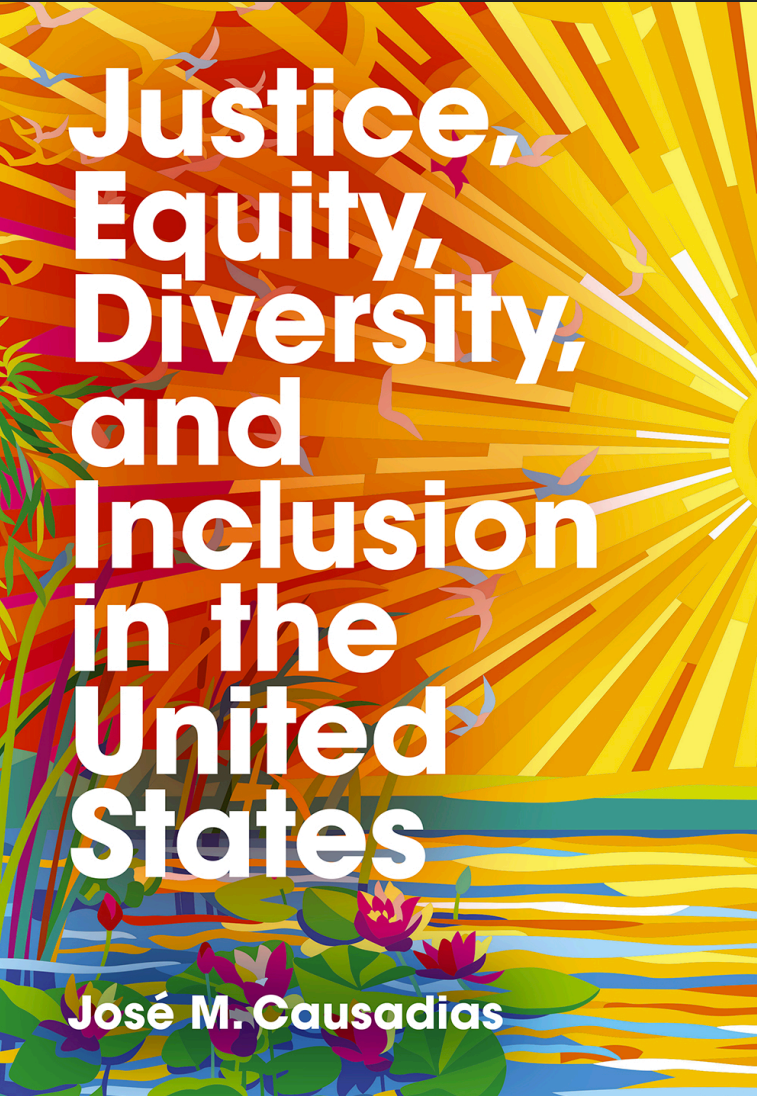
Justice, Equity, Diversity, and Inclusion in the United States. Cambridge University Press.
by Jose M. Causadias (2025)
This textbook provides students with basic literacy on key issues related to Justice, Equity, Diversity, and Inclusion in the United States. Over twelve chapters, it employs critical race theory and intersectionality to promote critical thinking and civic engagement on issues such as American culture, gendered racism, and Black reparations. Each chapter employs interactive and engaging opportunities to learn, making it the ideal introductory resource for undergraduate students.
The text is structured around real-world stories, which exemplify the humanity of each person and the complexity of these issues. Causadias presents questions for further discussion or to enhance comprehension, defines key concepts, debunks popular myths, summarizes evidence from trusted sources that challenge misinformation and disinformation, and proposes in-class exercises. Curated reading lists can be found at the end of every chapter for readers to expand their understanding of different topics.
This is an Open Access Textbook available for all to learn.
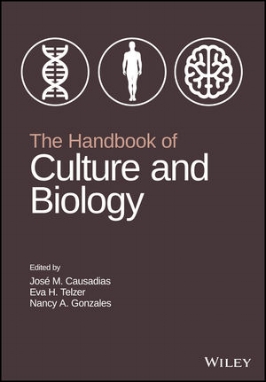
The Handbook of Culture and Biology. New York: Wiley.
by Jose M. Causadias, Eva H. Telzer, Nancy A. Gonzales (2018).
A comprehensive guide to empirical and theoretical research advances in culture and biology interplay
Culture and biology are considered as two domains of equal importance and constant coevolution, although they have traditionally been studied in isolation. The Handbook of Culture and Biology is a comprehensive resource that focuses on theory and research in culture and biology interplay. This emerging field centers on how these two processes have evolved together, how culture, biology, and environment influence each other, and how they shape behavior, cognition, and development among humans and animals across multiple levels, types, timeframes, and domains of analysis.
The text provides an overview of current empirical and theoretical advances in culture and biology interplay research through the work of some of the most influential scholars in the field. Harnessing insights from a range of disciplines (e.g., biology, neuroscience, primatology, psychology) and research methods (experiments, genetic epidemiology, naturalistic observations, neuroimaging), it explores diverse topics including animal culture, cultural genomics, and neurobiology of cultural experiences. The authors also advance the field by discussing key challenges and limitations in current research.

A teoría del apego: Investigación y aplicaciones clínicas [Attachment theory: Research and clinical applications]. Madrid: Psimática.
by Torres de Cádiz, B., Causadias, J. M., & Posada, G. (Editors)
Esta obra representa la primera revisión comprehensiva sobre la teoría del apego, sus métodos y aplicaciones que se realiza en castellano con la participación de un nutrido grupo de autores del ámbito iberoamericano. Hasta ahora, los lectores hispanoparlantes no disponían de ningún manual sobre la teoría del apego en castellano que sirva como fuente básica de referencia de este enfoque de la comprensión del desarrollo humano y que incluyera, además, un conjunto de estudios realizados en el contexto socio-cultural de Iberoamérica
Special Issues &
Sections
Special issue “Cultural Development and Psychopathology”. Development and Psychopathology.
Causadias, J. M., & Cicchetti, D. (Editors) (2018).
Special issue “New Directions in Developmental Science with Youth Experiencing Marginalization”. American Psychologist.
Causadias, J. M., & Umaña-Taylor, A. J. (Editors) (2018)
Special section “Culture and Biology Interplay”.Cultural Diversity and Ethnic Minority Psychology.
Causadias, J. M., Telzer, E. H., &, Lee, R. M. (Editors) (2017)
Miscellaneous Publications & Reports
The relevance of cross-national studies on early attachment: Research advances in Latin America. Bulletin of the International Society for the Study of Behavioural Development.
Causadias, J. M., & Posada, G. (2013).
Maternal incarceration, separation, and child development: Evidence and alternatives. Santiago de Chile: United Nations Children’s Fund (UNICEF).
Sroufe, L. A., & Causadias, J. M. (2012).